This week, I want you to think about using audio for particular rhetorical situations by creating a mix playlist with a group of songs.
Rules (all of which are breakable, if you have a good justification for why):
I usually think of a mix tape as about an hour of music, but for our purposes let’s aim for 45 minutes or so
Preferably no more than one song by a single artist
Create some kind of consistency and an audio progression as someone listens from beginning to end
Just as giving a speech, writing an essay, or publishing a photograph are rhetorical acts, choosing particular pieces of music in particular situations can also be a rhetorical act — and choosing to curate a specific list of songs that you put together in a particular order, with a particular emotional or intellectual affect in mind, is certainly a rhetorical act. In the case of the music mix you are producing for this assignment, the rhetor is you, the medium is your playlist, and the audience is probably your peers in the class (though you can decide to address some other, fairly specific, audience if you would like).
There is a lot of music in the world, and there are lots of ways to combine music together and lots of people doing so. If you are struggling to come up with ways to craft your mix, I encourage you to either respond to a very specific rhetorical situation (“a mix for my good friend who just went through a bad breakup,” for example, or “a mix to apologize to my friend for not locking up his bicycle when I borrowed it so it get stolen”); come up with a very specific narrative or emotional hook that you want from the songs you include in your list (“songs about the summer” or “songs to prepare for exams to” might work well as hooks that are topical right now); and/or to make up some specific rules for yourself to spur greater creativity (“My Halloween mix can only include songs with the word ‘pumpkin’ in the title” or “all the songs need to include the words ‘new’ or ‘old’” or “every song must be 2 minutes and 42 seconds long“). As Robert Frost once said, “Writing free verse is like playing tennis with the net down,” so creating rules for yourself about choosing songs might help you to structure the game that you’re playing to make it more fun.
What do you have to turn in?
Create your playlist however makes sense for you — it can be a Spotify playlist that you share via a link; you can use Mixcloud (which will also import Spotify playlists) or Soundcloud; or you can record your vinyl onto MP3s and upload those files to Google Drive or send them to me to host on my server, then embed them on your site from there. Publish a post on your site with the link(s) to the playlist and a numbered track listing that names the songs and artists.
Your mix tape needs an image to serve as the album cover. If you were recording your mix onto cassette tapes, I’d ask you to use gel pens to draw a cover that you’d stick into the little plastic case, but you’re not, so instead create a square image that has the title of your playlist and that serves as a compelling visual representation of your mix. Do not just use the image that Spotify automatically creates from the album covers included in the mix — design your own album cover.
Finally, write a reflection to accompany your mix — explain the rhetorical situation you are addressing, what rules you established for yourself, and how you went about solving the problem your rhetorical situation presents. Articulate the choices you made and why you made them. Finally, think about your mix as an argument (even though it’s not a direct, academic argument) — what are you conveying in your mix and how?
Now that you’ve completed your Literacy Narrative Comic, publish a reflective blog post of about 500 words about the writing process, paying special attention to how the work you have done has helped you to meet the Learning Outcomes for this class. That post should link to the page with your literacy comic.
Some other questions you might respond to: How was it different to write your literacy narrative as a comic? How did you think differently once the visual component was added? How did that help you to see the story you were trying to tell in different terms? Was your analytical thinking process any different? How have your thoughts about your alphabetic literacy narrative changed in the process of transforming it into a comic?
I’d also like you to discuss choices you made in creating your comic and to explain why you chose the way you did. Especially if there’s something you were really trying to do in your comic which you felt you couldn’t realize as perfectly as you would if you had a lot more time, more resources, or if you could have hired an illustrator to turn your vision into exactly what you wanted. If there are aspects of your comic where you have a clear sense of what you were trying to accomplish and how you would have done so if some things were different, then explain that in your reflection. Doing so allows you to demonstrate that you have the knowledge you need about this sort of writing even if you have not yet developed all the skills necessary to make that knowledge visible in the final artifact you’ve produced
Export your halfa kucha slideshow as a set of images (in Powerpoint: File > Export… and then in File Format select jpeg and “save every slide.” Powerpoint will create a subfolder where you tell it to and save each of your ten slides as images). Then in your WordPress dashboard create a new post and upload those images to a Slideshow block.
If you used Google Slides, you can embed the slideshow by going to File > Publish to the web and then selecting settings. It will give you an embed code that you can paste into an HTML block in your post.
Then write a couple of paragraphs reflecting on the process of writing and then giving the presentation. How was it different to construct an argument that you were giving to the class as a presentation than to write an essay? How did you make choices about the structure of your argument? If you made a choice to organize your presentation in a certain way so that your audience would follow it more clearly, is that something that you could also make use of in your written work? Was your analytical thinking process any different?
What decisions did you make about the visuals for your presentation? How did you go about creating an impact for the slides that accompany your spoken words?
What did you learn by giving this type of presentation, where you had no control of the timing of the slides and couldn’t put much in the way of text on your slides, as compared to other presentations you have given? What did you notice about your classmates’ presentations that you might think about incorporating into your own presentations in the future?
What do you think you could have done better in your presentation?
Add this site to your bookmarks. Make certain that you can find your way back here, because you’ll be spending a lot of time visiting these pages over the course of this semester.
Join the class Slack Workspace. Slack is a collaboration and communication tool that our class uses to work together to share ideas, discuss readings, collaborate on projects, and engage with learning.
Sign up for a basic, free WordPress site. (See further information below about choosing a name for your site.) Do not pay anything for this site; choose the free version with an address ending in .wordpress.com. Make sure to hit the “Launch” button to publish your site to the web.
Leave a comment on this post asking a question about the syllabus. Put the URL for the WordPress site you created in the “website” line on the comment form. If you want to receive an email every time a new post goes up on this site, check the “Subscribe to site” box before you submit your comment. The first time you comment, it will not show up publicly until I’ve approved it.
Reply to the survey form at the bottom of this post, which both asks some basic information I’ll need in order to manage communications with you and also asks some questions that will help me get to know you a little bit better.
Read the following three texts: Andrea Lunsford, “Rhetorical Situations” and “Reading Rhetorically” from Everyone’s an Author; Scott McCloud’s “Setting the Record Straight” from Understanding Comics; and Allie Brosh’s, “Adventures in Depression, Part One” from Hyperbole and a Half. (Note that first two links will take you to the PDF that I’ve uploaded to our electronic course reserves, so you will need to login with your Emory netid and password to access the document. The other link goes to Hyperbole and a Half on blogger. Allie Brosh has since published the story in her book, Hyperbole and a Half, which is excellent, but we can use this version on the web for this course.)
A little more on naming your WordPress site
You can choose a URL based on some version of your name (i.e., janestudent.wordpress.com or johndoe.wordpress.com) if you’d like. Using a version of your name has the advantage that you will be building a digital identity on the web based on your name, which can be really helpful. On the other hand, it also means that this site that you’re building will likely come up near the top of web searches for your name, so consider whether that is something you would like.
If you don’t want to publish your coursework on a site with a version of your name, you can also use some sort of pseudonym for your domain name.
It is also perfectly acceptable for your domain name to be a short word or phrase that is easy to remember and spell, and which speaks to some interest of yours or an aspect of your character (for example: my friend Audrey Watters, a noted educational technology scholar and researcher publishes a site called hackeducation.com or one of my favorite art and design blogs is called thisiscolossal.com). If you’re going to choose a title or phrase as your domain name, make sure you think about it very carefully so you don’t show up on one of those lists of the most unfortunate domain names ever, like the design firm called Speed of Art that ended up with a domain name that sounds like it’s about flatulence in a swimsuit. Note that in the case of your site, you’ll be publishing a page that’s a subdomain of WordPress.com, so if Audrey Watters were in this class her site might be called hackeducation.wordpress.com.
Once you have completed your Tracing project and published the pages to your site, you need to publish a reflection post as well. The post serves to turn the project in when it syndicates to the class site, and is also an opportunity for you to explain your process in the work you just completed.
Your reflection post should link to the main page for your project and also to the assignment prompt. Tell us in the post what the thesis of your essay is and give a one or two sentence preview of your argument.
You should also address the following questions:
Before writing your essay, you went through a pretty involved process of tracing and annotating two pages from the books. Briefly explain what that process was like for you — probably this was very different from most other writing you’ve done, so try to explain what was useful about the process for you. What productive thoughts or analysis occurred through the act of tracing and annotating?
For this assignment, I asked you to be very conscious of writing an inductive essay with an ABT thesis at the end, which is probably a pretty foreign way to structure an essay for you. How did your writing process change to address this assignment?
This assignment is a close reading exercise focused on identifying aspects of the “secret language of comics,” the series of choices the authors make in crafting comics that probably pass by many readers with little or no conscious notice. Do you feel that this assignment helped you to get in on this secret language? Do you understand Stitches and Fun Home better after having written this project? What’s the single biggest insight you gained about the two books during the process of tracing, annotating, and analyzing these pages (maybe something you “knew” on some level before you started but that you really get now, or maybe something you hadn’t really noticed until you worked on the project)?
Now that you’ve completed your Literacy Narrative Comic, publish a reflective blog post of about 500 words about the writing process, paying special attention to how the work you have done has helped you to meet the Learning Outcomes for this class. That post should link to the page with your literacy comic.
Some other questions you might respond to: How was it different to write your literacy narrative as a comic? How did you think differently once the visual component was added? How did that help you to see the story you were trying to tell in different terms? Was your analytical thinking process any different? How have your thoughts about your alphabetic literacy narrative changed in the process of transforming it into a comic?
I’d also like you to discuss choices you made in creating your comic and to explain why you chose the way you did. Especially if there’s something you were really trying to do in your comic which you felt you couldn’t realize as perfectly as you would if you had a lot more time, more resources, or if you could have hired an illustrator to turn your vision into exactly what you wanted. If there are aspects of your comic where you have a clear sense of what you were trying to accomplish and how you would have done so if some things were different, then explain that in your reflection. Doing so allows you to demonstrate that you have the knowledge you need about this sort of writing even if you have not yet developed all the skills necessary to make that knowledge visible in the final artifact you’ve produced
Walden, Tillie. Detail from "Drawn in an airport a few years ago. I finished right as the plane was boarding, and after the plane took off I realized I had left my pencil case behind. I’m still upset about this." Sketchbook.
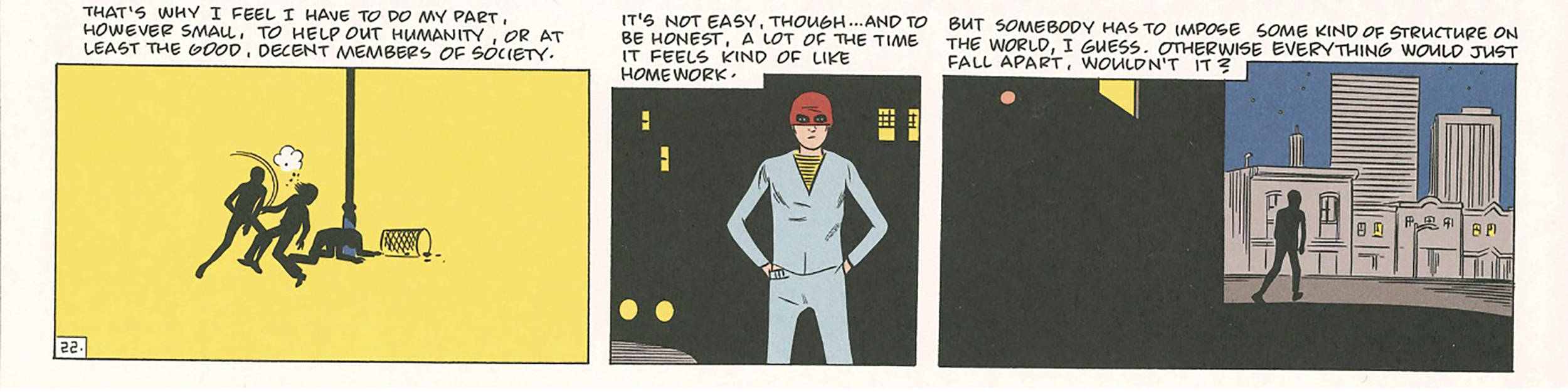
King, Tom and Mitch Gerads. Mister Miracle. USA: DC Comics, 2019. Detail from cover.
King, Tom and Mitch Gerads. Mister Miracle. USA: DC Comics, 2019. Detail from alternate cover.
Sacco, Joe. Paying the Land. Metropolitan Books, 2020. Detail from page #?
Chris Ware, Building Stories. New York: Pantheon, 2012.
I don't even know how to describe which page this image comes from, since Building Stories is a box full of booklets and pages and a fold-out board... it's the first half of the page from the middle of the booklet with the old woman dozing on the cover.
Chris Ware, Building Stories. New York: Pantheon, 2012.
Look back over the writing you’ve encountered and produced this semester, and then draft a cover letter for your portfolio that explains how you have met the learning outcomes for this course. This letter is an opportunity to think about your writing and clarify — for yourself and portfolio readers — how your skills and awareness of your writing processes have grown this semester. Think of each piece of writing included in your portfolio as an “exhibit” that you are analyzing and reflecting on in this letter.
What should your letter do?
Explicitly address the course outcomes and how you encountered them throughout the reading and writing for the course.
Guide your readers through the exhibits, discussing your writing while looking for larger patterns. What do you see about yourself as a writer when you step back and look at the work you’ve produced this semester?
Discuss at least one piece of writing in depth, considering the stages of the writing process as it developed. How did you think about audience, purpose, or genre while you wrote this piece?
Explain how you have applied (or will apply in the future) insights from this course in your other classes or other rhetorical situations. Use specific examples, if possible.
Employ evidence to support your claims. Just like in the other writing assignments you’ve completed this semester, you will need evidence to support of your argument; however, in this case, the evidence you will use is your own writing.
Remember that you need to incorporate quotes into your own writing with clear framing language.
Also remember that you always need your own interpretation and analysis of any quote you use in order for it work as evidence.
Forms of evidence from your writing exhibits could include, but are not limited to: quotes from your own finished writing (embedded in sentences or longer quotes in blocks); quotes from early drafts of your writing or notes; reported or quoted feedback from others; illustrations or quotations that show how a particular exhibit evolved; or screenshots or images from your work.
Publishing your cover letter
The reflection essay should become the new home (or index) page for your course site and should begin with a note indicating that the site is an archive of the work that you completed as part of ENG101 at Emory University during spring semester 2018. You should link to the course site, so that a reader who is going through your work can easily find out more information about the course you were in.
You should organize the work on your course site into a finished portfolio showing all the work you have done this semester. Make certain that your entire course subdomain looks complete, coherent, and like you’ve given some thought to its overall design and aesthetics.
Just like with any assignment you’ve completed this semester, your reflection letter should include at least one image (though you can certainly include more than one. You might consider using your Assemblies image as the primary or feature image for your letter — hopefully constructing that chart will help you to think about how the work you have completed this semester fits together, and hopefully it will help to communicate that understanding to your readers.
A pecha kucha is a particular style of oral and visual presentation where speakers present while showing 20 slides, each one timed to display for exactly 20 seconds. Hence, every pecha kucha presentation lasts for 6 minutes, 40 seconds.
Here’s a sample pecha kucha, which I chose almost at random from the pecha kucha site, called “Drawing to Document,” by Charis Loke:
For your third major project this semester, you’ll perform something akin to a pecha kucha, but in order to keep the scope of the assignment manageable and to have enough time for you to give your presentations to the class, we’re cutting the number of slides you’ll have in half — so you’ll have exactly 200 seconds, with 10 accompanying images, to present your argument.
The ordinary response to atrocities is to banish them from consciousness. Certain violations of the social compact are too terrible to utter aloud: this is the meaning of the word unspeakable.
Atrocities, however, refuse to be buried. Equally as powerful as the desire to deny atrocities is the conviction that denial does not work. Folk wisdom is filled with ghosts who refuse to rest in their graves until their stories are told. Murder will out. Remembering and telling the truth about terrible events are prerequisites both for the restoration of the social order and for the healing of individual victims.
The conflict between the will to deny horrible events and the will to proclaim them aloud is the central dialectic of psychological trauma. People who have survived atrocities often tell their stories in a highly emotional, contradictory, and fragmented manner that undermines their credibility and thereby serves the twin imperatives of truth-telling and secrecy. When the truth is finally recognized, survivors can begin their recovery. But far too often secrecy prevails, and the story of the traumatic event surfaces not as a verbal narrative but as a symptom.
The psychological distress symptoms of traumatized people simultaneously call attention to the existence of an unspeakable secret and deflect attention from it. This is most apparent in the way traumatized people alternate between feeling numb and reliving the event. The dialectic of trauma gives rise to complicated, sometimes uncanny alterations of consciousness, which George Orwell, one of the committed truth-tellers of our century, called “doublethink,” and which mental health professionals, searching for calm, precise language, call “dissociation.” It results in protean, dramatic, and often bizarre symptoms
And here’s another quote from the same book:
Recovery unfolds in three stages. The central task of the first stage is the establishment of safety. The central task of the second stage is remembrance and mourning. The central focus of the third stage is reconnection with ordinary life.
Assignment Fundamentals
Due: In class presentations on 4/5 and 4/7. (We’ll spend the first 45 minutes of each class on presentations. Please be sure to attend class on these days and be a good, attentive, respectful audience for your peers.)
Medium: This presentation will take the form of a “halfa kucha,” which means that you will create ten slides that will each stay on the screen for 20 seconds before automatically progressing to the next slide. Each slide should have a compelling visual image on it with no or very minimal text. Over the three minutes and twenty seconds of the slideshow you will explain your argument orally to the class. I will ask you afterwards to export the slideshow as a video or PDF to publish to your site along with a description of your argument.
Audience: The audience is your classmates, so they have read and thought about and discussed the books — you should not waste time summarizing the plot or giving basic background information that we’ve already discussed in class. But just like with other assignments this semester, assume that you are the smartest, most perceptive reader in the class and you have noticed things the rest of the class has not.
Tone: You can choose a tone ranging from casual to “academic casual” to very formal. Whatever fits your argument, personality, and presentation style the best. Remember, though, that you’re talking about trauma — so if you decide to be casual, still be respectful to the subject and to the sensibilities of your audience.
Title: You are required to have a really good, interesting title for your presentation.
Prompt
Thinking about the two quotes from Herman above and Hillary Chute’s “Introduction: Women, Comics, and the Risk of Representation” that we read earlier this semester, present to the class an argument about how two or three of the books we have read this semester investigate and represent trauma and healing.
Reflection Prompt
Once you have completed your presentation, I’ll ask you to either send me the slides or ask you to host them on your sites — the latter is preferable but might be too much of a pain with the WordPress.com sites you’ve got. Then you’ll write a reflection post and link to your presentation wherever it lives.